
AI Knowledge Base& RAG Systems
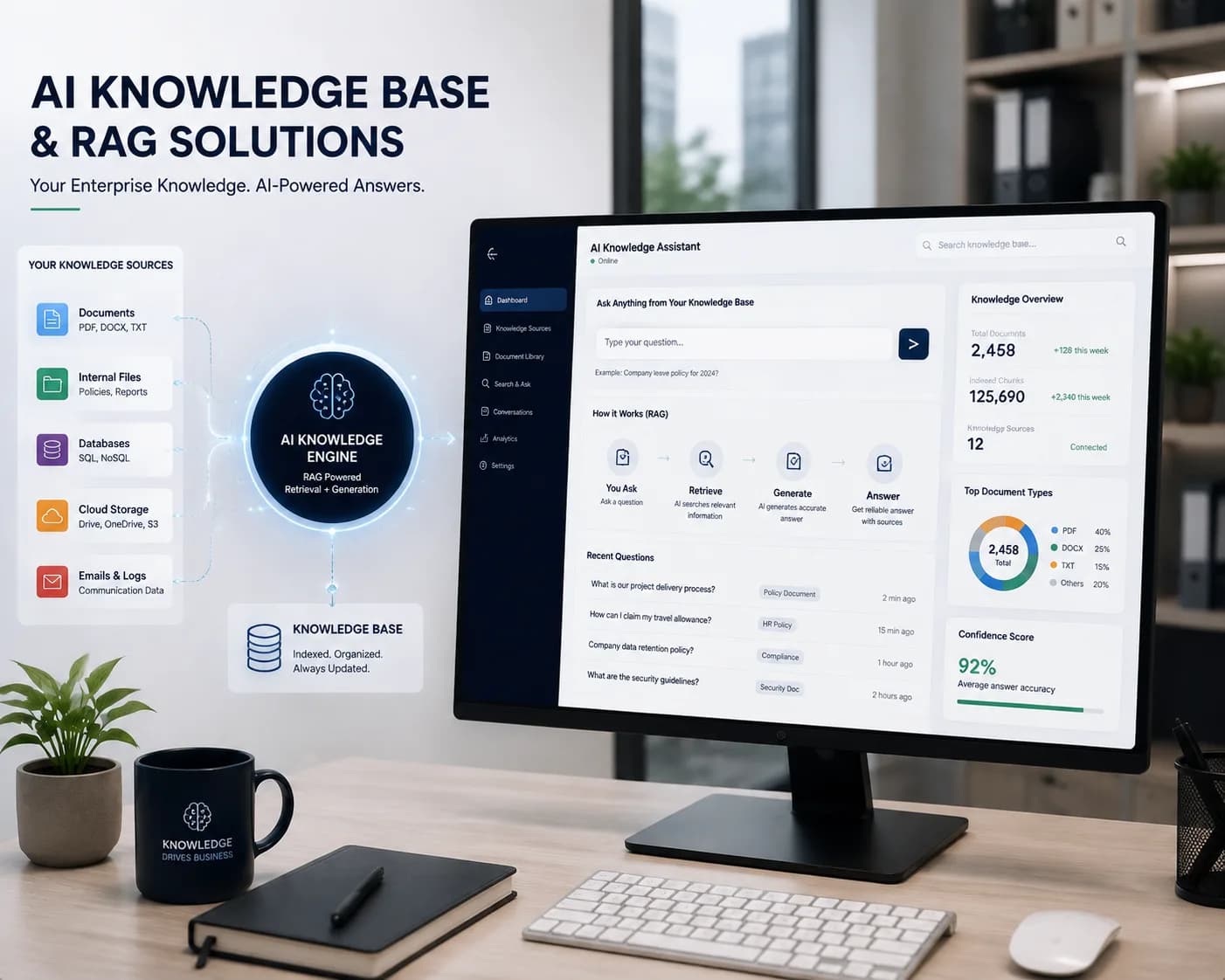
Staff and customers type an ordinary question and get the answer pulled from your actual manuals and policies, with a citation linking to the exact page.
- Cites Its Source
- Bangla + English
- Says When It Doesn't Know
- Live in 3–6 Weeks
Source-Grounded Answers
Every answer traces to something you actually wrote, not the model's general knowledge.
Cited Source Attribution
Click through to the exact document and section it was pulled from.
Role-Based Access Control
HR content stays with HR; a customer sees only what's meant to be public.
Real-Time Content Updates
Swap the PDF and the next answer reflects the change.
Answer Questions from Your Own Documents with AI
RAG is a way of making an AI system answer from a specific, named set of documents. A question first triggers a search of your own files for the relevant passages, and only those passages are passed to the model to build an answer from. Because every answer traces back to retrieved text, the system can cite its source — and when nothing relevant turns up, it says so plainly, without guessing at something plausible.
Key Features of AI Knowledge Base & RAG
Confidence isn't the point. The point is a compliance officer can click straight through to the paragraph and check it herself.
- Content-Aware Retrieval
- Documents are indexed the way they're actually structured — clause by clause for contracts, step by step for manuals — so the passage retrieved is the one that answers the question.
- Cited Source Attribution
- Each response links to the exact document, page and section it drew from, verifiable in one click.
- Confidence-Aware Responses
- No relevant passage means it says so and points to a human contact, not a confident guess dressed up as fact.
- Permission-Based Retrieval
- Access rules run first, so a user is never shown a passage from a document they aren't entitled to open.
- Bilingual Document Support
- Handles a mixed library and answers in whichever language the question arrived in.
Business Benefits of AI Knowledge Base & RAG
- ↓
- Staff stop pinging a colleague to ask what the policy actually says.
- 1×
- Everyone reads from the live document, not an email from eight months ago.
- ✓
- Every response carries its source, so nothing rests on someone's word.
- 24/7
- The knowledge doesn't clock off when the one person who holds it does.
Fewer repeat questions
One current answer
Answers that check out
Available after hours
How Our RAG & Knowledge Base Process Works
Most of the effort sits in the content itself, so that's where the work starts.
Swipe to see all 5 steps →
Common Use Cases for AI Knowledge Base & RAG
HR and policy helpdesk
Leave rules, benefits and conduct policy answered from whatever the current handbook actually says.
Product and technical support
Specifications, compatibility and troubleshooting steps pulled straight from manuals and datasheets.
Contract and compliance lookup
Finds the clause, the obligation and the date across hundreds of agreements in seconds.
Onboarding new staff
New joiners query the system directly instead of interrupting the two people who know everything.
- Financial Services
- Healthcare & Clinics
- Manufacturing
- Education & Training
- Professional Services
- Government & NGO
- Logistics & Delivery
- Telecom & Utilities
How this might play out
A realistic, hypothetical scenario to show what changes — not a real client or a specific deployment.
Staff ask HR the same leave and benefits questions over and over, and the answer depends on who picks up the question and how well they remember the current handbook — two different answers on the same day isn't unusual.
Staff get an instant answer pulled from the current handbook, with the clause it came from attached. HR stops fielding the same five questions daily, and everyone is reading from the same version of the policy.
Frequently Asked Questions
01How is this different from a normal AI chatbot?
A general chatbot answers from whatever the model absorbed during training. This answers only from documents you supply, and shows exactly which ones. For policy, compliance and technical content, that's the entire point.
02How much does a RAG system cost in Bangladesh?
It scales with how large and messy your document library is, not your user count. A few hundred clean PDFs is a small job; twenty years of scanned files is a different project entirely. We quote after reviewing a sample.
03How long does it take to build?
Three to six weeks for a document set that's already reasonably organised. Anything needing scanning, cleaning or de-duplication first takes longer, and we'll say so before we start, not partway through.
04Can it read scanned documents and images?
Yes, through OCR, Bangla text included. Accuracy tracks scan quality, so we test a sample from your archive before we commit to a timeline.
05What stops it from inventing answers?
It only answers from passages it actually retrieved, and we set a relevance threshold below which it declines to guess. That threshold gets tuned with you, and every answer carries its sources, so anything wrong is visible on the spot.
06Can we control who sees which documents?
Yes. Permissions apply at retrieval time, so restricted content is never even considered for a user without access — no cleverly worded question gets around it.
07What happens when a policy is updated?
You replace the document where it already lives, and the index picks up the change. There's no separate content to maintain by hand, which is exactly what keeps these systems from going stale after six months.
08Is RAG the same as fine-tuning a model?
No — they solve different problems. Fine-tuning retrains the model on your material, which changes how it writes but gives you no way to point at a source, and needs redoing every time your content changes. RAG leaves the model untouched and retrieves the relevant passage at answer time, so it can cite where an answer came from and picks up a document swap immediately. For policies, manuals and contracts, where an answer with no traceable source is a real liability, that's the better fit.
Related services
- AI Document IntelligencePull structured fields out of invoices and forms directly.
- AI Chatbot & Customer SupportPut these sourced answers in front of customers directly.
- Custom AI AgentsLet something act on what the knowledge base finds.
- Bengali Language AIBuilt for a document library that's Bangla-first.
- Private & Local AI DeploymentKeep sensitive documents inside your own network.
- AI Analytics & Business IntelligenceQuery your data as directly as you query your documents.
Ready to Get Answers from Your Own Documents?
Talk with our AI experts to identify knowledge base opportunities and build a RAG solution that fits your business.