
Private AI Deployment& On-Premise Hosting
Run AI models on servers you own or a private cloud you control, connect them to your core banking, HIS or ERP systems, and keep every prompt and document inside your own network.
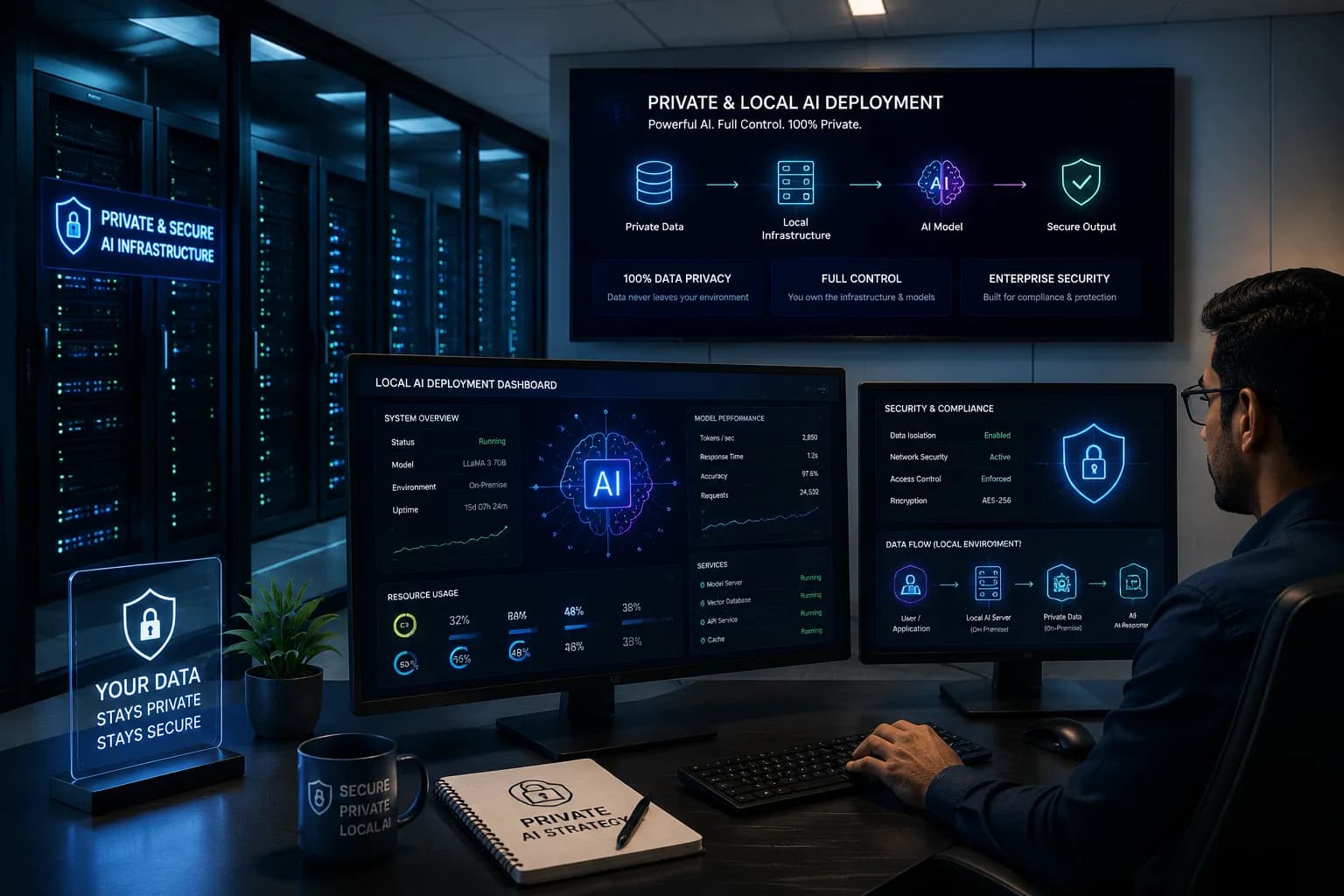
- Data Stays In-House
- No Public API Calls
- Works Fully Offline
- Full Audit Logging
No Outbound API Calls
Every prompt and document gets processed on infrastructure you control, full stop.
Data Residency Compliance
Built for sectors where sending records outside the organisation isn't permitted.
Offline-Capable Deployment
Fits environments where the connection drops, or never existed to begin with.
Predictable Fixed Costs
You pay for hardware and support — not a fee that climbs every time usage grows.
Run Your AI on Infrastructure You Control
Private or on-premise AI deployment runs a language model on servers you own or a private cloud tenancy you control, instead of calling a provider's public API. Every prompt, document and response then stays inside the organisation's own network, which is the property regulated industries actually need. The catch is real: self-hosted open models trail the largest commercial APIs in raw capability, and the buyer now owns the hardware, capacity planning and maintenance a public API used to handle invisibly.
Key Features of Private AI Deployment
Compliance drives this decision more than engineering does. We measure your actual workload and size hardware to that number, not to whatever a vendor's default quote assumes.
- Firewall-Contained Deployment
- Model, vector store, application layer and logs all stay on infrastructure you own. There are no outbound calls to a model provider — the exact thing an auditor will make you prove.
- Complete Query Logging
- Per-user permissions and a full log of every query, kept for as long as your policy requires.
- Right-Sized Infrastructure
- We benchmark your real workload first and specify GPU and memory against that number. A vendor's default recommendation is usually bigger than you need.
- Internal System Integration
- Connects to core banking, HIS, ERP or your document store from inside the network — nothing routes through the public internet.
- Ongoing Patching & Security
- Patching, monitoring and controlled model upgrades, so the deployment doesn't quietly become the oldest unpatched system on your network.
Business Benefits of Private AI Deployment
- 0
- Every record stays on infrastructure inside your own walls.
- ✓
- You can show exactly where every query was processed, on request.
- ↓
- The bill is fixed — hardware and support — however much the system gets used.
- 24/7
- Someone else's outage or price change elsewhere doesn't touch you.
Records leaving the network
Defensible to an auditor
No per-token surprise
Independent of a vendor
How Our Private AI Deployment Process Works
Start by checking whether this is actually required — plenty of workloads don't need it.
Swipe to see all 5 steps →
Common Use Cases for Private AI Deployment
Banking and financial records
Search and analysis over customer data too sensitive to hand to a third party.
Patient records and clinical notes
Summarising and searching clinical notes without those notes ever leaving the hospital network.
Government and citizen data
Citizen data processed on infrastructure that stays within national or departmental boundaries.
Confidential legal and contract work
Contract review where a confidentiality obligation rules out sending files externally.
- Financial Services
- Healthcare & Clinics
- Government & NGO
- Telecom & Utilities
- Legal & Professional Services
- Defence & Security
- Manufacturing
- Education & Training
How this might play out
A realistic, hypothetical scenario to show what changes — not a real client or a specific deployment.
A corporate law firm needs help summarising contracts and searching years of case files, but its confidentiality agreements block sending any of that material to a public AI API.
The firm runs the same summarisation and search on a model hosted entirely on its own servers. No client file leaves the building, and a partner can prove it to any client who asks.
Frequently Asked Questions
01Is a self-hosted model as good as ChatGPT or Gemini?
Not at the top end, generally. Open models have gotten a lot better and handle retrieval, summarisation, extraction and classification just fine, but the largest commercial models still win on complex reasoning. We benchmark against your actual tasks so you can see whether that gap matters for what you need.
02What hardware do we need?
It depends on model size and how many people use it at once. A departmental knowledge base needs a very different spec than a system serving thousands of people simultaneously. We size it from your measured workload and show the working.
03Can it run without any internet connection?
Yes. Once it's deployed, the system needs no outbound connectivity to operate. Internet access only matters for updates, which can run on a schedule you control.
04How much does private AI deployment cost in Bangladesh?
Three cost lines: hardware or private cloud, our implementation, and ongoing support. Upfront cost runs higher than an API-based build, and total cost often runs lower at high volume. We model both against your expected usage before you commit.
05Can we use our existing servers?
Sometimes. Most general-purpose business servers lack the GPU capacity a language model needs to run at usable speed. We assess your current hardware before recommending a purchase.
06Who maintains it after handover?
Either your team or ours. We train your administrators as part of delivery, and a support agreement covering patching, monitoring and model upgrades is available for teams that would rather not carry it internally.
07Can we start on a public API and move to private later?
Yes — often the sensible path when your data allows it. We build the application layer so the model underneath can be swapped, which means migrating later doesn't mean rewriting everything.
Related services
- AI Knowledge Base & RAGThe workload most often deployed this way.
- AI Document IntelligenceKeep confidential document processing inside your own walls.
- Custom AI AgentsAgents that only ever touch your internal systems.
- AI Server HostingGPU capacity to rent if buying hardware outright doesn't make sense.
- Dedicated Server HostingHardware that's yours alone, sitting in a managed facility.
- Bengali Language AIBangla language handling on a model you host yourself.
Ready to Deploy AI on Infrastructure You Control?
Talk with our AI experts to identify where private deployment applies and build an infrastructure solution that fits your business.